
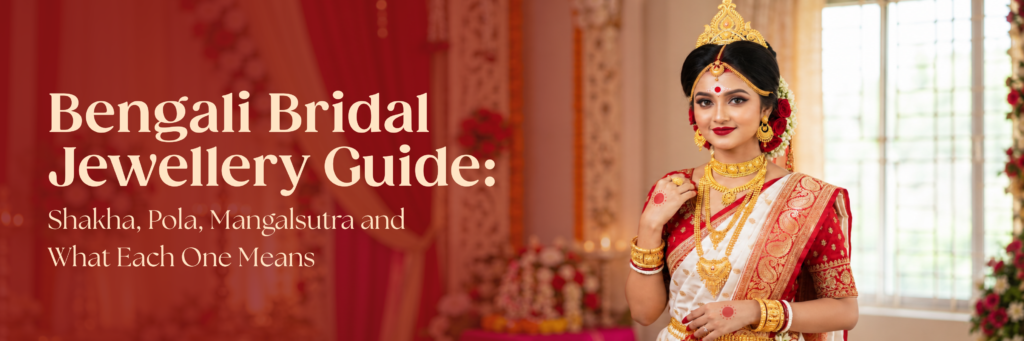
Bengali bridal jewellery isn’t just about looking beautiful on your wedding day — every piece carries meaning that goes back generations. If you’re a bride-to-be trying to understand what you actually need, or simply curious about the traditions behind the pieces you’ve seen at every Bengali wedding, this guide walks through each one.
Shakha and Pola: The Heart of Bengali Bridal Tradition
Shakha and Pola are perhaps the most recognisable symbols of a married Bengali woman — the white and red bangles worn together on both wrists. Shakha is made from conch shell, ground and shaped into bangles, while Pola is made from red coral. Together, they’re worn from the wedding day onward as a visible marker of marital status, similar in cultural significance to how sindoor is worn in many North Indian traditions.
The white of the shakha is traditionally associated with purity and peace, while the red of the pola represents fertility, vitality and prosperity. Many brides today choose to have their shakha and pola gold-plated or paired with gold accents — sometimes called “shakha pola with gold kaap” — where thin gold caps are added at the ends for a more festive, jewellery-like finish without losing the traditional symbolism.
When choosing yours, comfort matters as much as appearance, since these are meant to be worn daily for years. It’s worth trying a few sizes in person rather than ordering based on a general size chart, since conch and coral bangles don’t have the same give as gold ones.
Mangalsutra: A Sacred Thread Reimagined in Gold
While the mangalsutra is a pan-Indian tradition, Bengali interpretations often carry regional design touches — think delicate gold chains with black beads, sometimes paired with a small gold pendant featuring traditional motifs. The black beads are traditionally believed to ward off evil, while the gold represents prosperity and an auspicious union.
Bengali mangalsutra designs tend to favour finer, more delicate chainwork compared to some other regional styles, often finished with a simple pendant rather than an elaborate one — a reflection of the understated elegance that runs through a lot of traditional Bengali jewellery. That said, contemporary versions blend in more diamond work and layered chains for brides who want a piece that transitions from wedding day to everyday wear afterward.
Tikli: The Finishing Touch
The tikli, or maang tikka, sits at the parting of the bride’s hair, with a chain running down the centre of the forehead to a pendant that rests just above the brows. In Bengali bridal styling, it’s often paired with an elaborate hairstyle and other traditional headpieces, completing what’s typically the most photographed part of the bridal look.
Tiklis range from simple gold chains with a small pendant to elaborate pieces studded with kundan or polki work matching the rest of the bridal set. If you’re building a full bridal look, it’s worth choosing your tikli alongside your other pieces rather than as an afterthought, since it needs to sit well with your hairstyle and the rest of your jewellery without visually competing with it.
Building a Complete Bridal Set
Most Bengali brides layer these traditional pieces with a broader jewellery set that might include a necklace (often a choker paired with a longer layered piece), earrings, and bangles beyond the shakha-pola. When planning your full look, a good approach is to decide on your saree and blouse colour first, then build your jewellery around it — gold naturally complements red and maroon bridal sarees, while pieces with coloured stone work can either match or intentionally contrast with lighter bridal shades.
It also helps to think about weight and comfort across a full wedding day. Bengali wedding ceremonies often run long, with multiple rituals across several hours, so brides frequently choose a slightly lighter primary set for the actual ceremony and save heavier, more elaborate pieces for the reception.
Choosing Between Traditional and Contemporary Styling
Many brides today aren’t choosing between tradition and modern style — they’re blending both. It’s increasingly common to see a traditional shakha-pola and mangalsutra worn alongside a more contemporary diamond necklace, or a classic tikli paired with a minimalist choker rather than a heavier traditional set. If you want guidance on what pairs well together, working with a jeweller who understands both traditional requirements and current bridal trends makes it much easier to build a set that feels authentically you.
Necklaces and Earrings: Completing the Bengali Bridal Look
Beyond the traditional pieces, a Bengali bridal necklace often follows one of a few recognisable styles. The rani haar, a long, elaborate necklace typically reaching down to the chest, is a popular choice for the main wedding ceremony, often layered with a shorter choker for added visual depth. Temple jewellery-inspired designs, featuring motifs of deities and traditional patterns, are another common choice, particularly for families who want to lean into a more classic, heritage-driven look.
For earrings, jhumkas — bell-shaped danglers — remain a firm favourite, often chosen to match the necklace’s design language. Chandbalis, crescent-shaped earrings, are a slightly more contemporary alternative that still reads as traditional enough for bridal wear. Whichever style you choose, it’s worth trying earrings on with your planned hairstyle beforehand, since some styles sit better with hair worn up versus down.
Coordinating Jewellery With Your Saree and Blouse
Since most Bengali bridal looks centre around a red or maroon Banarasi or Tant saree, gold jewellery is almost always a safe, complementary choice regardless of the exact shade. If your blouse or saree includes heavy zari or stone embroidery, it’s often better to let one element — either the outfit or the jewellery — take visual priority rather than competing for attention. A heavily embroidered blouse pairs beautifully with a slightly simpler jewellery set, while a more understated saree gives you room to go bolder with a statement necklace or elaborate tikli.
Budgeting for a Complete Bridal Set
A full Bengali bridal jewellery set — shakha-pola, mangalsutra, tikli, necklace, and earrings — represents a significant investment, and it’s common for families to plan this budget well in advance rather than deciding piece by piece close to the wedding date. A practical approach many families take is prioritising the mangalsutra and one primary necklace as the pieces with the most lasting everyday use, while treating more elaborate ceremonial pieces as items that can be rented, borrowed, or chosen in lighter, more affordable versions if the budget is tighter.
Passing Down and Preserving Bridal Jewellery
Many of the pieces bought for a Bengali wedding aren’t meant to be worn once and set aside — traditional gold pieces, in particular, are often intended to be passed down to the next generation, whether that’s a daughter, daughter-in-law, or niece. If you’re buying with this longer-term intention in mind, it’s worth choosing slightly more classic, timeless designs for at least a few key pieces — like the main necklace or a pair of earrings — rather than styles that are heavily tied to a specific current trend, since these are the pieces most likely to be worn again by someone else years down the line. Getting a valuation certificate and keeping original purchase documentation also makes future resizing, insurance, or even resale considerably easier when the time comes.
Frequently Asked Questions
Do shakha and pola need to be pure conch and coral, or can they be gold?
Traditionally they’re made from conch shell and red coral, though gold-accented versions with thin gold caps are widely worn today, blending tradition with a more jewellery-forward look.
Can the mangalsutra be worn daily after the wedding?
Yes, and most Bengali brides do wear it daily. Lighter, thinner chain designs are often chosen specifically because they’re comfortable for everyday wear.
Is a tikli mandatory for a Bengali bridal look?
It’s a traditional part of the complete bridal look and commonly worn, though it’s ultimately a personal styling choice rather than a strict requirement.
How far in advance should bridal jewellery be ordered?
For custom or made-to-order pieces, ordering at least six to eight weeks ahead gives enough time for fittings and any adjustments, especially during the busier wedding season months.
What’s the difference between a rani haar and a choker?
A rani haar is a long necklace typically falling to chest length, while a choker sits snugly around the neck — the two are often layered together for a fuller bridal look.
A Simple Pre-Wedding Jewellery Checklist
As you get closer to the wedding date, it helps to work through a short checklist: confirm shakha-pola sizing in person rather than guessing, decide whether your mangalsutra will be a daily-wear or occasion-only piece, coordinate your tikli and hairstyle choice together rather than separately, and settle on your saree or blouse colour before finalising your main necklace design so everything is chosen to complement each other rather than compete.
Final Thought
Bengali bridal jewellery carries centuries of meaning in every piece, and getting the right combination is as much about tradition as personal style. Our Beleghata and Baguiati showrooms carry both classic and contemporary interpretations of shakha-pola, mangalsutra, and tikli sets, and our team can help you put together a complete bridal look that honours tradition while fitting the way you actually want to wear it.